





Spain continues its path towards a more robust electric ecosystem, although the day-to-day experience for drivers still varies widely. In the first ten months of 2025, the country surpassed 200,000 electrified registrations and reached a 17.2% market share — a figure that signals a structural shift in consumer behaviour.
Yet, as demand rises, infrastructure is struggling to keep pace, creating a visible strain on the roll-out.
This contrast is most evident across the public network. Spain currently has 48,907 charging points, according to AEDIVE — a 7.77% increase compared with the end of 2024. At face value, the number appears solid and reflects sustained investment by local councils, private operators and major retail groups. But the real story lies elsewhere: in the power available.
Chargers between 50 and 250 kW grew by more than 80% in a year, while those above 250 kW increased by 53%.
The data shows a clear shift towards mid- and high-power charging — a direct response to what real drivers actually need: fast, straightforward charging without obstacles.
This evolution is also reshaping the role of retail in eMobility.
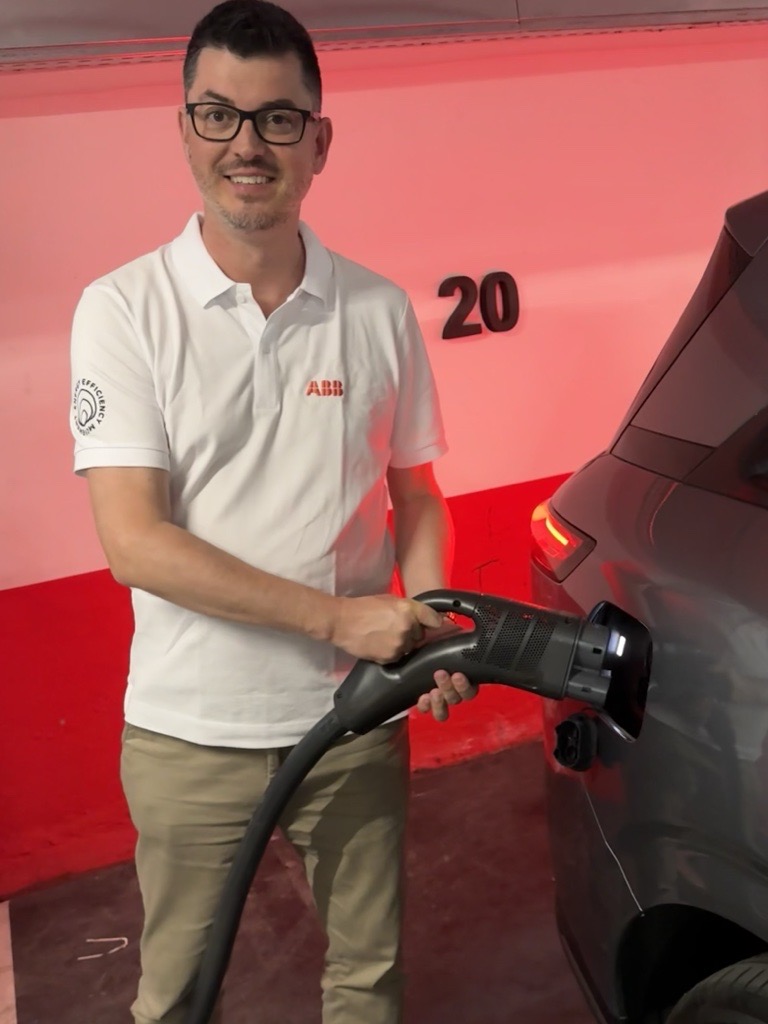
Schwedhelm observes a consistent pattern across supermarkets, hypermarkets and shopping centres: drivers typically stay on-site for 45 minutes to an hour.
This seemingly short dwell time is enough to determine what type of infrastructure really makes sense. And on this point, he is unequivocal.
“In 40 or 45 minutes, charging with AC power at 3.5 to 11 kW simply doesn’t pay off. In many cases, it’s barely worth plugging in,” he says.
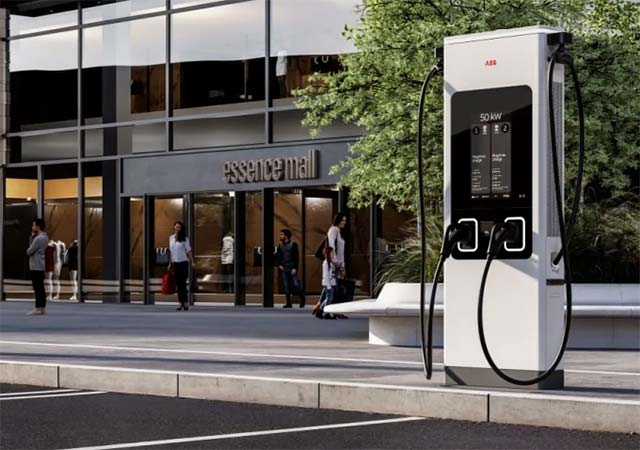
For these retail dwell times, ABB E-mobility typically recommends compact DC solutions in the 50 kW range, which strike a balance between power, footprint and grid constraints.
One example is the C50, a compact DC charger specifically designed for short to medium dwell times such as supermarkets and retail parks, allowing drivers to recover a meaningful amount of range during a standard shopping stop.
From his perspective, AC charging often becomes little more than a symbolic gesture — the psychological comfort of “topping up because I’m here”, rather than a meaningful boost in range.
DC, by contrast, offers tangible value. It allows drivers to recover a usable amount of energy during a typical shopping trip, while providing operators with a clearer business case: higher tariffs, better turnover and a service the customer genuinely appreciates.
But technology alone isn’t the sector’s biggest challenge. Spain faces an increasingly critical bottleneck: thousands of charging points have been installed but not yet electrified.
They are physically in place, appear on maps and sometimes even show up as operational — yet they don’t charge.
Schwedhelm recalls a now-familiar scenario for EV drivers. On a recent trip between Barcelona and Zaragoza, he found only one site with chargers actually switched on; the rest were installed but inactive.
This gap between installation and commissioning not only slows the expansion of the network — it erodes user trust and discourages adoption.
The reasons behind the delays are varied: slow permitting, limited capacity on the low-voltage grid, bottlenecks with distribution companies, lengthy municipal procedures and a lack of coordination between stakeholders.
According to Schwedhelm, the sector has begun responding with battery-based storage systems that allow sites to go live even where available grid capacity is insufficient.
Batteries — increasingly common in central Europe and in some Spanish projects — act as a temporary bridge, accelerating go-live dates and preventing chargers from sitting idle and unprotected for months.
“Leaving a charger unused for a year benefits no one — not the manufacturer, not the operator. We’re starting to see improvements in processes and a growing recognition that downtime is a cost the industry can no longer absorb,” he explains.
Beyond infrastructure, ABB E-mobility is placing emphasis on another factor that is rapidly shaping market competitiveness: usability. Hardware may be robust and power plentiful, but if the charging process isn’t intuitive, drivers simply disengage.
“We often arrive at a station and don’t know whether to plug in first, pay first or select the connector. Guiding users intuitively is one of the greatest contributions we can make to eMobility,” says Schwedhelm.
ABB E-mobility received industry recognition this year for its work on user experience — an area often overlooked but increasingly decisive for the competitiveness of public charging networks — with a clear focus on simplifying the entire charging journey through more intuitive and predictable interactions for drivers.
This focus was recognised on April 28 in Berlin, when ABB E-mobility received two iF Design Awards for its A400 All-in-One charger, including the iF Design Award Gold for User Interface Design.
The jury highlighted the charger’s ability to combine a compact physical design with a highly accessible UX, helping users navigate increasingly complex charging technologies with ease.
Following this recognition, the A400 was also named a 2025 Red Dot Award winner in the Product Design category, reinforcing the idea that usability and design are becoming central factors in building trust, improving reliability and supporting the wider adoption of electric mobility.
Meanwhile, BEV and PHEV uptake shows no sign of slowing. The Tesla Model 3 leads pure-electric registrations, while BYD continues to strengthen its position in the plug-in hybrid segment.
Madrid accounts for nearly 42% of national demand, reflecting a pattern ABB E-mobility has observed in other regions as networks stabilise and operators transition towards higher-power, more user-centric models.
The underlying message is clear: Spain sits at an inflection point between growth and maturity. The vehicle volumes are already here; the installed power is increasingly sufficient.
The challenge now is ensuring the infrastructure works — reliably, intuitively and profitably.
For ABB E-mobility, retail is not a testing ground but one of the most strategically important arenas in this new phase.
In a country where millions of people visit supermarkets each week, electrifying these everyday destinations is key to making e-mobility practical and accessible, and ultimately to enabling wide adoption.
Discover Mobility Portal Data
Discover Mobility Portal Data, a new, exclusive market-intelligence platform offering reliable datasets and essential reports to support informed decision-making across the automotive sector—from combustion and electric vehicles to charging infrastructure.
Research, trend analysis and well-organised statistics, presented with clarity and precision, together with up-to-date insights—all just one click away. With Mobility Portal Data, better decisions are within reach.
READ MORE
-
chargecloud Expands Marketplace with AI-Based Support: Cooperation with Lemonflow Technologies
The integration brings 24/7 AI-powered user support, fully embedded into the chargecloud ecosystem, aiming to enhance operational efficiency and service quality for CPOs across Europe.
-

EV transition in Europe slows, but momentum remains after EU climbdown
EU policy flexibility may ease short-term pressure on automakers, yet rising EV sales, infrastructure needs and long-term investment signal that electrification remains the industry’s core trajectory.
-
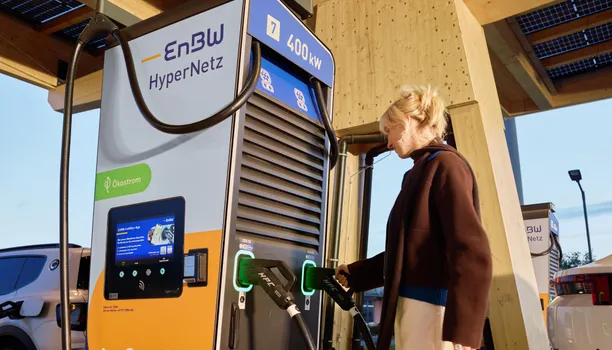
EnBW and Alpitronic strengthen long-term partnership to scale high-power charging across Germany
The agreement covers fast-charging hardware, joint development of future functionalities and a multi-year maintenance framework to support EnBW’s expanding HPC network.